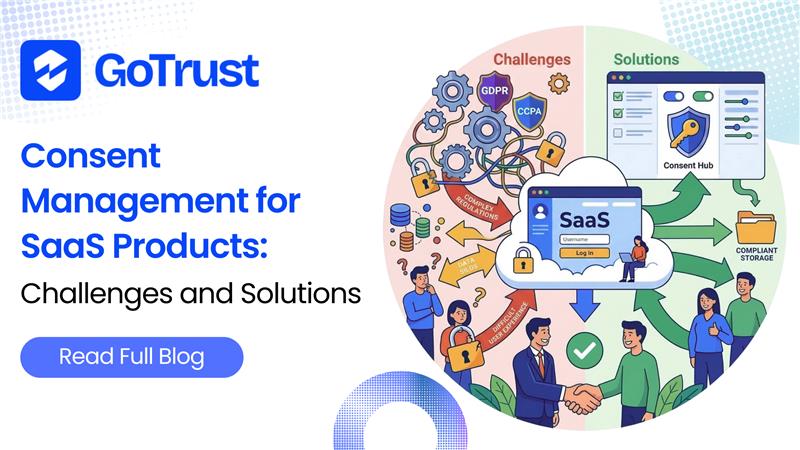
Consent Management for SaaS Products: Challenges and Solutions
Mar 17, 2026
Article by
Introduction
SaaS products must navigate complex consent management under India’s DPDP Act, 2023. Unlike single-domain websites or mobile apps in controlled environments, SaaS platforms must handle consent across many customer tenants, varied user roles, third-party integrations, API-based data transfers, and multi-product suites. The DPDP Act’s requirements, consent must be free, specific, informed, unconditional, and unambiguous, given through a clear affirmative action with simple withdrawal apply directly, but implementing these in SaaS brings significant technical and operational complexity.
Take a SaaS platform for project management. It may collect personal data for core functions (authentication, collaboration, storage), analytics, support, marketing, and integrations with external tools like payment gateways or calendars. Each purpose requires itemised consent in accordance with the DPDP framework. Simultaneously, the platform must support different enterprise customers with unique compliance needs and user bases, often spread across various geographies. Consent management must handle verifiability, instant withdrawals, and reliable audit records, requiring both engineering and legal solutions.
Challenge 1: Multi-Tenant Consent at Scale
Most SaaS platforms use a multi-tenant model: one application serves many customers (tenants), keeping their data separate but using shared infrastructure. Consent management is complex in this system. Each tenant’s users are data principals under the DPDP Act, and the SaaS provider must get and honour their consent. However, tenants may want different things: one might want to collect and manage consent with its own branding, another might prefer the SaaS provider to do so, and a third might want to link with an official Consent Manager as mentioned in Section 6(9) of the DPDP Act.
Designing consent for multi-tenancy requires configuration for each tenant without duplicating the data model. For example, consent from User A in Tenant X for analytics must be independently recorded and enforced separately from User B's consent in Tenant Y. Withdrawing User A's consent must not affect User B. Additionally, platforms must aggregate consent states across tenants for compliance and auditing.
GoTrust’s consent management platform addresses this by treating consent as a tenant-scoped, purpose-specific object from the outset. Every consent record links to a tenant identifier, a user identifier, a defined purpose, and a timestamp. Tenant administrators can configure consent flows, branding, and language independently. Meanwhile, the central platform keeps a unified schema for consistency and auditability across all tenants. When a data principal withdraws consent, the platform changes it only within the relevant tenant, preventing cross-tenant leakage or errors.
Challenge 2: SDK and API-Driven Consent Flows
SaaS platforms often deliver features via APIs, SDKs, or microservices, making it impractical to display consent banners directly. Consent must be captured inside API authentications, SDK initialisations, or automated backend processes, depending on how the features are accessed. This requires technical mechanisms tailored to each integration context.
The DPDP Act does not explain exactly how to capture consent. It only says consent must meet the legal standard and be provable. So, getting consent through an API call or SDK is fine if the user saw the right information, made a clear choice, and the platform can prove it. For SaaS providers, the challenge is ensuring that every API, SDK, and third-party app follows the same rules and maintains consistent records.
GoTrust’s approach treats consent as a ‘central, system-agnostic object’ rather than a field buried inside each application. The platform provides consent management via SDKs, APIs, and embeddable user interfaces that can be integrated into various environments: web frontends, native mobile apps, server-side microservices, and even command-line tools. Each SDK or API call captures the consent event with full metadata purpose, timestamp, IP address, user agent, the exact text of the notice presented and stores it centrally. This ensures that whether consent is collected via a web form, a mobile app prompt, or a programmatic API call, it is recorded in the same structured format and subject to the same enforcement and audit rules.
In SaaS with many integrations, such as a project management tool connecting to multiple third-party apps, each integration can trigger new data-processing events. GoTrust’s SDK model displays specific consent prompts when integrations activate, records consent at that time, and blocks data transfers if consent is later withdrawn. The SDK updates all relevant systems to enforce withdrawal in real time.
Challenge 3: Granular, Purpose-Specific Consent in Multi-Product Suites
Many modern SaaS platforms are no longer single products; they are suites of interrelated services. A workplace collaboration platform might offer messaging, video conferencing, file storage, task management, and calendar synchronisation, all under one subscription. From a user’s perspective, these feel like different features of a unified product. From a DPDP compliance perspective, they are distinct processing purposes, each requiring separate, itemised consent.
The DPDP Act does not allow bundled consent. Section 6(1) says consent must be specific and only for the necessary data for that purpose. A single checkbox for "I consent to all features and services" is not allowed. Instead, the platform must ask users for separate consent for each feature: for example, consent for messaging (name, photo, messages), consent for video (audio/video), consent for file storage (documents, logs), analytics (usage data), and more.
The main challenge is balancing detail and user experience. If users see ten separate consent requests at first login, they get consent fatigue and either quit or just click “accept all.” GoTrust prevents this with contextual, progressive consent. Instead of asking for all consents at registration, the platform prompts users only when they first use a feature. For example, when a user clicks “join a video call” for the first time, a clear, concise notice explains what data the feature collects and why, with a definite opt-in. Enabling a third-party integration triggers a separate, specific consent request.
This progressive model respects the DPDP requirement for purpose-specific consent. It also improves user experience by distributing consent decisions across the user journey. Withdrawal becomes more intuitive: users can later disable a specific feature or integration and withdraw consent for that purpose without affecting their use of other parts of the platform.
Challenge 4: Real-Time Consent Enforcement Across Distributed Systems
Enforcing consent in real time across distributed SaaS systems is difficult. In a typical multi-service stack (e.g., authentication, data storage, analytics, notifications, third-party APIs), consent withdrawal must instantly deactivate data use for the specified purpose across all services. For example, when a user removes consent for analytics, every microservice must immediately halt data intake, not wait for batch cycles or delayed updates.
The DPDP Act reinforces this expectation through Section 6(4), which requires that withdrawal of consent be as easy as giving consent, and Section 8, which places the burden of compliance on the Data Fiduciary. If a platform continues to process data after consent has been withdrawn, it is in breach, regardless of whether the failure is due to technical lag, architectural complexity, or oversight.
GoTrust’s real-time consent tracking and enforcement is designed precisely for this scenario. The platform maintains a central consent state store that acts as the single source of truth. When a data principal updates their consent preferences either through a preference centre, an in-app settings interface, or a programmatic API call the change is recorded immediately and propagated to all connected systems. GoTrust’s SDKs and APIs support both push and pull models: services can subscribe to consent change events via webhooks and react instantly, or they can query the consent API before each processing operation to check the current consent status.
For SaaS platforms with complex data flows, this means consent is not a static permission checked once at signup; it is a live control that dynamically gates processing. If a user withdraws consent for analytics, the analytics service receives a webhook notification within seconds and stops processing that user’s events. Logs and audit trails capture the exact time of withdrawal and the subsequent enforcement actions, creating a defensible record for regulatory review.
Challenge 5: Verifiable Consent Records and Audit Readiness
Under Section 6(10) of the DPDP Act, the burden of proof sits squarely with the Data Fiduciary: “Where a consent given by the Data Principal is the basis of processing of personal data and a question arises in this regard in a proceeding, the Data Fiduciary shall be obliged to prove that a notice was given by her to the Data Principal and consent was given by such Data Principal.” This means that SaaS platforms cannot simply assert that users consented; they must be able to produce verifiable evidence showing what notice was presented, when, in what language, what specific purposes and data categories were disclosed, what action the user took, and whether consent remains valid or has been withdrawn.
For SaaS platforms serving thousands or millions of users, maintaining this level of documentation manually is impossible. Every consent event initial capture, modification, withdrawal, re-consent must be logged with immutable timestamps, metadata, and audit trails. The platform must be able to answer questions such as: “What consent did User X give on 15 March 2025?” “What was the exact text of the notice they saw?” “Has that consent been withdrawn or updated since?” “Which systems relied on that consent, and when did they stop processing after withdrawal?”
GoTrust’s consent management platform treats every consent event as a verifiable, immutable artefact. When consent is captured, the platform records not only the user’s choice but also the full context: the exact text of the notice, the language in which it was presented, the timestamp, the channel (web, mobile, API), the IP address and user agent, and the version of the consent form. These records are stored in a tamper-proof audit log with cryptographic integrity checks. When a data principal or regulator requests proof of consent, the platform can generate a complete audit report showing the entire consent lifecycle for that individual, with supporting evidence for each event.
For SaaS platforms subject to audits, Data Protection Board investigations, or customer contract reviews, this capability transforms consent from a compliance risk into a demonstrable control. Instead of scrambling to reconstruct consent records from fragmented logs, the platform can export structured, timestamped evidence directly from GoTrust’s central repository.
Challenge 6: Consent Manager Interoperability
The DPDP Act introduces the concept of ‘Consent Managers’: registered entities that allow data principals to give, manage, and withdraw consent across multiple Data Fiduciaries through a unified interface. For SaaS platforms, this means that consent may not always be captured directly through the platform’s own interface. Instead, a data principal might use a registered Consent Manager to grant or revoke consent for specific purposes, and the SaaS platform must honour those decisions.
Sections 6(7) and 6(9) of the DPDP Act establish the framework for Consent Manager registration and operation, though the detailed technical standards and interoperability protocols are still evolving. What is clear, however, is that SaaS platforms will need to integrate with external Consent Managers, receiving consent artefacts in standardised formats, validating them, and enforcing them across their systems.
GoTrust’s consent architecture is designed with interoperability in mind. The platform supports ingestion of external consent artefacts via APIs, validates their authenticity, and maps them to the platform’s internal purpose and data category taxonomy. When a Consent Manager notifies the SaaS platform that a data principal has withdrawn consent for a particular purpose, GoTrust receives that notification, updates the central consent state, and triggers enforcement workflows across all connected services. This ensures that decisions made through external Consent Managers are treated with the same immediacy and rigour as consents captured directly through the platform’s own interfaces.
Challenge 7: Consent Versioning and Policy Updates
SaaS platforms evolve continuously. New features are added, data processing purposes change, third-party integrations are introduced or deprecated, and privacy policies are updated to reflect new practices or regulatory requirements. Each of these changes can affect the validity of existing consents. If a platform introduces a new processing purpose for example, using customer data to train a machine learning model existing consents do not automatically cover that new purpose. The platform must seek fresh consent from affected users, even if they previously consented to other uses of their data.
Similarly, if a platform materially changes its privacy policy expanding the categories of data collected, changing retention periods, or introducing new third-party processors it may need to re-seek consent or, at a minimum, notify users of the changes and give them an opportunity to withdraw. Managing this process at scale, across thousands or millions of users, multiple tenant environments, and distributed services, is a significant operational challenge.
GoTrust’s consent platform supports consent versioning and policy lifecycle management. Each consent notice is versioned, and the platform tracks which version a user consented to. When a new version is published reflecting a new purpose, data category, or policy change the platform can automatically flag users who consented under an old version and trigger re-consent workflows. These workflows can be configured to be non-blocking (users continue to use the platform but are prompted to review and update their consent) or blocking (users must review and consent to the new terms before accessing certain features), depending on the materiality of the change and the platform’s risk appetite.
This versioning capability is critical for SaaS platforms operating in fast-moving product environments. It ensures that consent remains aligned with actual processing practices, reducing the risk of non-compliance due to consent drift.
Operationalising SaaS Consent Management With GoTrust
Each of the challenges described above can, in theory, be addressed through custom development: building tenant-scoped consent databases, designing SDK wrappers for consent APIs, implementing real-time event propagation, maintaining audit logs, and integrating with Consent Managers. In practice, however, building and maintaining these capabilities in-house is resource-intensive, error-prone, and diverts engineering effort away from core product development.
GoTrust’s consent and preference management platform provides a purpose-built solution that SaaS platforms can integrate via SDKs, APIs, and embeddable UI components. The platform handles the complexity of multi-tenant consent management, purpose-specific granularity, real-time enforcement, verifiable audit trails, interoperability with the Consent Manager, and consent versioning, allowing SaaS engineering teams to focus on building features rather than on compliance infrastructure.
For SaaS platforms, the value proposition is clear: faster time to compliance, reduced engineering overhead, lower risk of consent-related breaches, and a defensible, audit-ready consent framework that scales with the business. As the DPDP framework matures and enforcement activity increases, the platforms that have embedded robust, automated consent management from the outset will be far better positioned than those relying on ad hoc, manually managed processes.
Conclusion
Consent management for SaaS products is not a one time compliance checkbox. It is an ongoing, technically demanding discipline that touches every layer of the product stack, from frontend UI and authentication flows to backend microservices, third party integrations, and data processing pipelines. The DPDP Act’s requirements free, specific, informed, unconditional, and unambiguous consent, given through clear affirmative action, capable of equally easy withdrawal, and subject to the Data Fiduciary’s burden of proof apply with full force, yet the multi-tenant, API-driven, distributed nature of SaaS makes straightforward implementation far from simple.
The challenges are real: managing consent across multiple tenants, integrating consent into SDK and API flows, balancing granularity with user experience, enforcing withdrawals in real time, maintaining verifiable audit records, interoperating with external Consent Managers, and versioning consent as products evolve. GoTrust’s consent and preference management platform addresses each of these challenges through a unified, purpose-built solution designed for SaaS environments. By treating consent as a central, enforceable, auditable object and providing the infrastructure to capture, track, and enforce it across distributed systems, GoTrust allows SaaS platforms to meet DPDP obligations without rebuilding their entire data architecture.