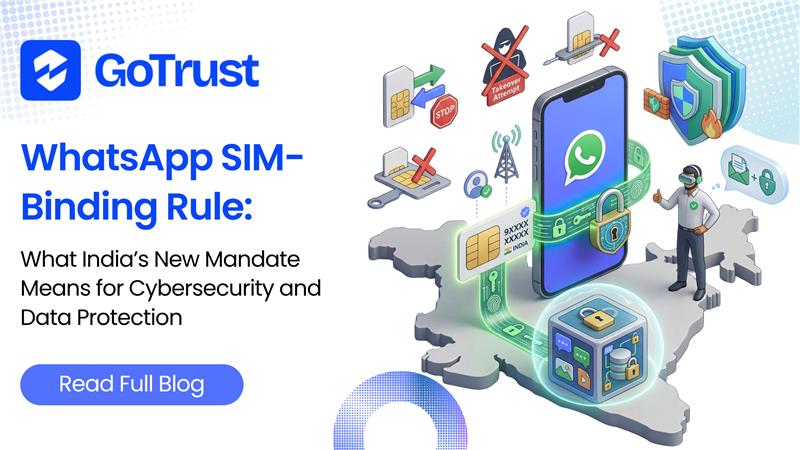
WhatsApp SIM-Binding Rule: What India’s New Mandate Means for Cybersecurity and Data Protection
Mar 27, 2026
Article by
Introduction
Effective March 1, 2026, India mandated SIM-binding for messaging applications, marking a significant regulatory shift. According to Department of Telecommunications (DoT) directives from November 28, 2025, platforms like WhatsApp, Telegram, Signal, and Snapchat must keep user accounts continuously linked to the physical SIM card in the primary device. Platforms must verify the SIM’s presence about every six hours, replacing the previous one-time onboarding verification.
For organisations managing data privacy and cybersecurity, the SIM-binding rule supports compliance with India’s Digital Personal Data Protection (DPDP) Act, 2023. It strengthens identity verification, limits unauthorised access, and aligns with the DPDP’s emphasis on security safeguards. This article examines the SIM-binding rule, its rationale, its impact on WhatsApp users, and the cybersecurity implications for Data Fiduciaries in India.
What Is the SIM-Binding Rule?
The SIM-binding rule, established under the Telecom Cyber Security (TCS) Rules, 2024 (as amended), requires app-based communication services using Indian mobile numbers to maintain a continuous link between the service and the user’s SIM card. Previously, platforms used a one-time verification model, allowing indefinite access after initial OTP-based registration, even if the SIM was later removed, deactivated, or transferred abroad.
Under this rule, continuous SIM presence is required for service access. Messaging platforms must verify approximately every six hours that the original SIM used for registration remains active in the primary device. If the SIM is removed, replaced, or deactivated, the application will not function until the original SIM is reinserted and verified. The following are the key technicalities involved:
Continuous SIM verification: Platforms must periodically check in the background that the registered SIM is present in the device running the application. This process does not require user action and uses device-level SIM detection.
Blocking upon SIM absence: If verification fails due to SIM removal, swapping, or inactivity, access to the messaging service is blocked. Users can regain access only after reinserting the original SIM and completing re-verification.
Web session timeout mandates: For web-based messaging services like WhatsApp Web, automatic logout must occur at least every six hours. Users must re-authenticate by scanning a QR code or entering an OTP from the device with the registered SIM, keeping web sessions linked to the primary device.
Scope limited to Indian numbers: The SIM-binding requirement applies exclusively to accounts registered with India’s +91 country code. International users operating accounts registered with foreign numbers are unaffected, even if they use the services whilst physically located in India.
The regulation designates affected platforms as Telecommunication Identifier User Entities (TIUE) under telecom regulations, subjecting them to cybersecurity oversight typically reserved for traditional telecommunications operators. Platforms were given a 90-day implementation window from the date of the directive’s issuance, with full compliance expected by March 1, 2026. Reports indicate that WhatsApp began rolling out in-app notifications in February 2026, informing select users: “Due to regulatory requirements in India, WhatsApp needs to check that your SIM card is in your phone.”
Why Has India Introduced the SIM-Binding Rule?
India’s decision to mandate SIM binding stems from escalating cyber fraud that exploits the decoupling between messaging service accounts and physical SIM cards. Building on this, the DoT explicitly stated that app-based communication services allowing users to consume services “without availability of the underlying Subscriber Identity Module (SIM) within the device” are being systematically misused to commit cyber fraud, particularly by actors operating outside India’s territorial jurisdiction.
Against this backdrop, India has witnessed a surge in sophisticated digital fraud schemes over the past three years, with messaging platforms serving as primary vectors. Prominent attack patterns include:
Digital arrest scams: Fraudsters impersonate law enforcement officials, tax authorities, or judicial officers and contact victims via WhatsApp or Telegram. They fabricate scenarios involving alleged criminal investigations, tax evasion, or customs violations, demanding immediate payment of fines or bail amounts. Victims are psychologically manipulated into maintaining continuous video or voice calls whilst transferring funds, under the threat of imminent arrest. These scams have defrauded thousands of individuals, with losses running into thousands of crores.
Government impersonation: Scammers use Indian mobile numbers registered domestically but access the associated WhatsApp accounts from abroad, often from regions with minimal law enforcement cooperation. They impersonate government officials, offering fraudulent subsidies, pensions, or enrolment in welfare schemes, and extracting personal information and financial credentials.
SIM-less account persistence: Traditional fraud relied on SIM cards physically present in India. Modern tactics involve registering accounts using Indian numbers, then removing or deactivating the SIM whilst continuing to access the account via WhatsApp Web or linked devices. This allows criminals to operate anonymously from foreign jurisdictions, complicating investigative efforts and jurisdictional enforcement.
Number reassignment exploitation: When users abandon phone numbers and telecom operators reassign them to new subscribers, the old WhatsApp accounts sometimes remain active if not properly deleted. Fraudsters exploit this by purchasing reassigned numbers, gaining access to residual accounts and contacts, and launching social engineering attacks.
Regulatory Justification
The DoT’s directive identifies SIM-binding as essential to “plug a concrete security gap that cybercriminals are exploiting to run large-scale, often cross-border, digital frauds.” By requiring continuous SIM presence, the regulation aims to:
Establish accountability: Tethering accounts to physical SIM cards, which are subject to Know Your Customer (KYC) requirements under Indian telecom regulations, creates a verifiable identity chain. This linkage enables law enforcement to trace fraudulent accounts back to the registered subscriber more reliably.
Prevent offshore misuse: Requiring physical SIM presence in the device effectively prevents criminals from operating Indian-registered accounts whilst physically located abroad, where they enjoy jurisdictional immunity from Indian law enforcement.
Disrupt persistent access models: The six-hour web session timeout and continuous verification requirements disrupt the model where fraudsters authenticate once in India, then operate indefinitely from remote locations without needing the original SIM.
Support investigative traceability: When fraud is reported, investigators can determine whether the suspect account had the registered SIM physically present at the time of the incident, providing evidentiary support for prosecution.
What Will Change for WhatsApp Users in India?
The SIM-binding mandate significantly changes WhatsApp’s operational model for Indian users, introducing constraints that affect daily usage, especially for those who rely on multi-device functionality, frequent travel, or extensive use of WhatsApp Web.
Impact on Multi-Device Usage
WhatsApp’s Companion Mode, introduced in 2021, allows users to connect to four additional devices to a single account without the primary phone remaining online. The SIM-binding rule limits this convenience. Linked devices now require periodic re-authentication through the primary device with the registered SIM. If the SIM is absent from the primary phone, all linked devices lose access until the original SIM is restored and verified.
WhatsApp Web and Desktop Client Constraints
Professionals and organisations relying on WhatsApp Web will face operational disruptions. The six-hour automatic logout requires web sessions to be re-authenticated multiple times daily. Each re-authentication involves accessing the primary phone, scanning a QR code, or entering an OTP. For those managing customer support, sales, or remote teams, this creates productivity challenges.
The six-hour timeout applies only to web and desktop sessions, not to the primary mobile app with the SIM installed. If the SIM is removed from the primary device, the mobile app stops functioning, making re-authentication of web sessions impossible until the SIM is restored.
Implications for International Roaming and Travel
Travellers using Indian mobile numbers abroad face specific challenges. The regulation allows compliance if the registered SIM remains active and present in the device while roaming. However, replacing the Indian SIM with a local SIM to avoid roaming charges will result in loss of WhatsApp access until the Indian SIM is reinserted.
Frequent international travellers may need to use dual-SIM devices to keep the Indian number active or accept periodic service interruptions when swapping SIMs.
Account Security and Identity Verification
From a security perspective, the SIM-binding rule strengthens account protection against unauthorised access. Since accounts require continuous linkage to the physical SIM, an attacker who steals login credentials or hijacks an account remotely cannot maintain access without physically possessing the victim’s SIM card. This reduces the risks associated with account takeovers via phishing, credential stuffing, or session hijacking.
User Experience and Adaptation
WhatsApp has started notifying users through in-app alerts about the upcoming periodic SIM verification. Beta versions of the Android app are testing background verification to minimise disruptions. Ideally, verification is silent unless the SIM is absent. However, challenges such as false positives, device compatibility, and verification delays may cause unexpected service interruptions during the transition.
Cybersecurity Benefits of the SIM-Binding Rule
From a cybersecurity and data protection perspective, the SIM-binding mandate offers several measurable benefits, particularly in identity assurance, fraud prevention, and regulatory compliance.
Enhanced Identity Verification and Accountability
Previously, messaging accounts remained active indefinitely after initial verification, separating the account from the physical SIM card. This allowed anonymous or pseudonymous use, which, while sometimes privacy-preserving, also enabled fraud. SIM-binding restores continuous identity linkage, ensuring every active account is tied to a KYC-verified subscriber.
Indian SIM cards are issued under strict Know Your Customer (KYC) norms, requiring identity documents, biometric verification, and proof of address. By mandating continuous SIM presence, the regulation extends these identity checks to messaging accounts. This strengthens accountability, allowing accounts to be traced to verified individuals and improving investigations into fraud or criminal activity.
Mitigation of Cross-Border Fraud
A significant share of cyber fraud targeting Indian users originates from actors outside India’s jurisdiction. Criminals register accounts with Indian SIM cards, then remove the SIM and operate accounts remotely via WhatsApp Web or linked devices. This separation complicates law enforcement, as suspects remain beyond Indian authorities’ reach.
SIM binding disrupts this model by requiring physical SIM presence within India or in a roaming-compliant scenario where the SIM remains active. Criminals abroad can no longer maintain access to Indian accounts without the device and active SIM, increasing their operational risk and cost.
Reduction of Account Hijacking and Unauthorised Access
Account takeover attacks, where adversaries gain unauthorised access through phishing, credential theft, or social engineering, are a persistent threat. Under the previous model, attackers could maintain access indefinitely, even if victims changed passwords or enabled two-factor authentication.
SIM-binding introduces a physical custody requirement. Even if attackers obtain credentials or session tokens, they cannot maintain access without the physical SIM card. This significantly reduces the risk of remote account hijacking, especially from abroad.
Alignment With DPDP Act Security Obligations
The DPDP Act, 2023, mandates that Data Fiduciaries implement “reasonable security safeguards” to prevent personal data breaches, with penalties reaching up to ₹250 crore for failures in this domain. Whilst the DPDP Act does not prescribe specific technical measures, it expects organisations to adopt controls that are proportionate to the sensitivity of the data processed and the risks involved.
For organisations using WhatsApp Business or similar platforms for customer engagement, customer support, or data collection, the SIM-binding rule enhances compliance with DPDP security expectations. By ensuring that accounts are continuously linked to verified identities, organisations reduce the risks of unauthorised access, data exfiltration via compromised accounts, and misuse of customer data by rogue actors operating hijacked accounts.
GoTrust’s data governance and compliance automation platform supports organisations in implementing layered security controls that complement regulatory mandates, such as SIM binding. Through robust access controls, identity verification workflows, and real-time monitoring, GoTrust enables Data Fiduciaries to operationalise DPDP security obligations, ensuring that personal data remains protected across all communication channels, including those subject to SIM-binding requirements.
Improved Incident Response and Forensic Capabilities
When cyber fraud or data breaches occur, rapid incident response depends on the ability to trace actions back to accountable entities. SIM binding enhances forensic traceability by ensuring that messaging accounts remain continuously linked to KYC-verified subscribers. When law enforcement or Data Fiduciaries investigate incidents, they can establish with greater confidence whether the suspect account had the registered SIM physically present at the time of the incident, providing evidentiary foundations for prosecution or remediation.
Whilst the SIM-binding rule introduces cybersecurity benefits, it also presents operational challenges and considerations for organisations managing data privacy compliance.
User Experience Friction: Periodic re-authentication requirements and SIM presence validation may frustrate users, particularly professionals who rely on multi-device workflows. Organisations using WhatsApp Business for customer engagement may experience reduced responsiveness if support staff face frequent logouts or verification prompts.
Privacy and Surveillance Concerns: Critics argue that continuous SIM verification enables greater government surveillance capabilities, as telecom operators and platforms gain persistent visibility into device-level SIM presence. For privacy-conscious users and organisations handling sensitive data, this raises questions about proportionality and data minimisation principles.
Interoperability and Multi-Jurisdiction Complexity: Organisations operating in multiple jurisdictions may face fragmented compliance, as SIM-binding applies only to Indian-registered numbers while global operations use different authentication models. Careful mapping of user bases and regulatory variations is required.
Vendor Risk and Third-Party Processor Implications: Organisations relying on third-party processors for customer support, sales, or data collection via messaging platforms must ensure that processors also comply with SIM-binding constraints and that any service disruptions do not trigger DPDP data subject rights violations or security breaches.
Conclusion
The WhatsApp SIM-binding rule marks a significant shift in India’s digital governance, prioritising cybersecurity and fraud prevention through continuous identity verification. For over 500 million Indian WhatsApp users, the mandate introduces operational constraints on multi-device use, web sessions, and SIM-swapping, balanced by enhanced accountability, reduced cross-border fraud, and stronger protection against account hijacking.
For Data Fiduciaries, the SIM-binding rule aligns with the DPDP Act’s focus on security safeguards, strengthening identity assurance and incident traceability. Organisations should assess how the rule affects communication workflows, customer engagement, and third-party relationships to ensure compliance does not disrupt service or violate data subject rights.
GoTrust’s data governance and compliance automation platform provides the infrastructure to manage regulatory changes like SIM binding within DPDP compliance programs. By automating access controls, identity verification, monitoring, and vendor risk management, GoTrust helps organisations meet regulatory mandates and user expectations. As cyber threats and regulatory demands increase, comprehensive governance frameworks are essential for building trust, resilience, and accountability in India’s digital economy.